Wednesday, August 1, 2012

SUMMER READING


As much as I loved hiking and fishing as a kid, I used to regret the arrival of summer in one way,  not because of the long hours I spent irrigating, weeding, and doing various farm chores, but because in the summer I lost access to the school library. You probably thought I was going to say because of those dreaded summer reading lists.  The truth is I never had a school teacher who gave me a summer reading list. Perhaps that was because I lived in a number of remote rural areas that lacked libraries, but I always read whatever I could get my hands on and I'll always be grateful to the Idaho State Library for mailing books to me every summer as long as I lived in that state and to the school teacher who introduced me to their great program for providing books by mail. I'm grateful too to the neighbor in Montana who signed for me to get a library card in a county where a year residency was required or the signature of a long time resident.


Today it is much easier to get a library card or buy books.  For most of us in America acquiring a library card is easy and there are numerous book stores, both brick and mortar as well as electronic, within easy reach.  Both Deseret Book and Seagull Book have mail order options for customers.  Outside of the Mountain West finding LDS books is a little harder though with the arrival of Kindle and Nook even those outside of the USA can easily and economically buy LDS books. There's another option too, which many readers underestimate.  Many authors offer their own and sometimes each other's books as contest prizes or in exchange for reviews.  Many of these contests are linked.


I've always loved curling up in a shady spot with a good book in the summer. Reviewing new LDS fiction for Meridian Magazine gives me the perfect excuse to do that, but by August the introduction of new fiction seems to slow down until the LDS Booksellers Convention introduces various publishers' new fall lines and as readers shift their focus from books to back-to-school clothing and supplies. This year attention is on the Olympics and squeezing in the last summer hikes, camping trips and boating before summer's end. There might even be more impetus to squeeze in outdoor activities than usual since our weather this year has left us unsure which season to expect when we wake up each morning. However, I suspect there are still a lot of people planning to read this month since many are still leaving on vacations and need a book to read in-flight, on the beach, or just because it's too hot to do anything else. 


Over on LDS Publisher there's a reading contest going on with two books being awarded to winners each day during the month of August. Those entering are asked to start with a list of books he or she plans to read this month. That's a little hard for me to do since most of the books I read are sent to me by publishers or authors to consider for reviews on Meridian and I don't know what they're going to send me. I just finished reading The Most Important Catch by Jaclyn M. Hawkes and have one more to-be-read book, Twitterpated by Melanie Jacobson on my Kindle. Traci Abramson and Gregg Luke have new books I'm anxious to get my hands on and a couple of independent authors have notified me they're sending me books, but most of the time I don't know what I'll be reading. That's one of the nice things about this contest, books can be added or deleted as the month goes along. Extra points are awarded for reading any of the sponsors' books or books by any LDS author. I'm a sponsor, but I'm also entering the contest as a reader and since I didn't start a book list when I blogged earlier about this contest I'm including it now..  Actually I find the instructions for reporting books read a bit confusing, but hopefully I'll figure it out.  Here's my list, but expect it to grow:

The Most Important Catch by Jaclyn M. Hawkes
Twitterpated by Melanie Jacobson
Code Word by Traci Hunter Abramson
Deadly Undertaking by Gregg Luke
Paige by Heather Moore
Faith, Hope, & Gravity by Merrill Osmond and Shirley Bahlmann
The Rent Collector by Camron Wright
Tangled Hearts by Roseanne Wilkins

My Loving Vigil Keeping by Carla Kelly

Bad Times at Horseshoe Bend by R. Bruce Sundrud

Saturday, July 28, 2012

Book Contests Coming Up in August

You may have noticed a new gadget on the sidebar of my blog.  It's an invitation to join LDS Publisher's Summer Book Trek.  It links to an explanation of the rules for the contest, which are easy.  Just sign up, post a list of the books you plan to read in August (you can add and delete all you want) read books, and report what you read.  You get extra points if you read any of the sponsors' books.  And hey!  I'm one of the sponsors.  Prizes are the books listed by the sponsors.  Go for it!

I'm considering linking to another book contest on August 18.  The Heirs of Southbridge will also be one of the possible prizes for winners of that contest.  I'll let you know more about it later.  Then in September I plan to go back to my usual Wish List contest.

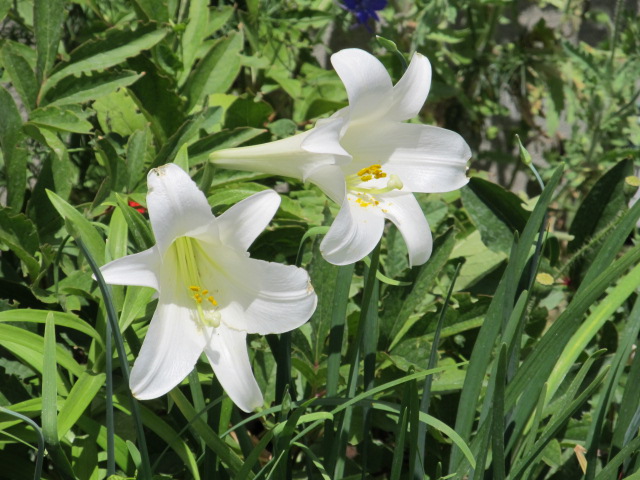
The rest of this blog has nothing to do with contests and is sheer indulgance on my part. My lilies were gorgeous this year and I just want to show off some of the pictures I took of them.


Wednesday, July 25, 2012

HOME AGAIN


We're back from a five day family reunion vacation at the May Ranch south of Challis, Idaho.  It's along the Middle Fork of the Salmon River and is a fun place for a large group to gather.  There were only about thirty-five of us since this seemed to be our family's year for complications that kept most of the family from attending.  We weren't sure we'd be able to go because of my health problems, but I was okay until the last day when I was nauseated and cramping all the way home.  It seems that's how life works; we make plans, then life adjusts them.


A son-in-law and I did some fishing and we took some of the kids fishing.  Rich and I mostly catch and release since we neither one like to eat fish, but I caught one trout that swallowed the hook too far so I had to keep it. We don't throw dead fish back in the water or leave them lying around to rot, so we decided we'd better clean it, take it back to the ranch, and see if someone wanted to eat it.  Rich laid it out on a rock while he went back to the truck for a knife.  He turned back around just in time to see an eagle take off with the fish. Problem solved.


Another son-in-law is an avid photographer.  He kept watching an eagle nest in a tree not far from the ranch house and one evening an eagle chick landed on a nearby tree where we were all able to watch it and get close up views with binoculars.  Steve and the owners' son jumped in a truck and headed to another point to take pictures.  When they got close they were able to see that not only was the chick in the tree, but down farther hidden to us at the ranch by foliage, was one of the parent eagles.  He got some great pictures which I hope he'll post when they get back (they went on to Yellowstone for a few days.)


We not only found watching the eagles soar above the ranch a great sight, but we saw an elk herd, lots of deer, egrets, and some of our group (not me) saw mountain sheep.  Of course there was an abundance of squirrels in various sizes and varieties as well as meadows full of geese with their little ones.


One day we went to a little ghost town up Yankee Fork that has been converted to a museum so the kids could pan for gold.  They each found a fleck or two.  There's a big gold dredge near there that in its heyday really churned up the creek bed.  Another day we drove up a horrendous narrow road to Bayhorse Lake.  It's beautiful, but I don't think we'll do that again.  Narrow trails hugging shale slopes aren't my thing.


The highlight for the kids was the huge waterslide at the ranch.  They spent hours shooting down it.  I think their next favorite activity was catching minnows and water skippers.  One niece collected 17 minnows in a metal box, then carefully turned them all back into the stream before she left.  I think the adults' favorite activity was eating.  We did a lot of that and it was all great.


I usually take a lot of pictures when we travel anywhere, but I didn't take many this time.  Between forgetting to take my camera with me most of the time and not feeling completely well, I left most of the picture taking to Janice and Steve.  Maybe they'll let me borrow their pictures.

Tuesday, July 17, 2012

Speaking Jitters


I have a speaking engagement tonight and I'm leaving on vacation tomorrow, so naturally instead of thinking about my talk or packing, I've been wasting time on Face Book. I did a candy survey to see how many kinds of candy out of a choice of 100 different kinds I've tried.  I got a score of 75.  Obviously I have a sweet tooth. I learned all kinds of interesting tidbits; I just can't remember any of them right now.  I saw a cute picture of my granddaughter, Gracie, checked out the wedding decorations my young friend Kristie did for a recent wedding, and saw the bruises on a great nephew's leg where he got zapped by an electrical accident.  My phone and my Kindle are both plugged into their chargers so I guess I'm getting ready in a way.


Stalling is probably the word for what I'm doing; you see I'm a bit nervous about tonight.  Speaking doesn't usually worry me too much if I'm talking to book people; we share a common language and love.  Tonight's talk has nothing to do with reading or writing. I've been asked to talk on a subject I dearly love, but have a difficult time expressing my feelings about because it touches my emotions so strongly.  You see, I've been asked to talk about temples and temple service.  I've served in the temple for four years now and since I'm basically a storyteller, there are plenty of stories I'd love to share; unfortunately most are too sacred to speak of outside the Lord's House.  It's a difficult task for me to speak on a topic that touches my emotions, one where I have to be careful not to overstep what is appropriate, and one where I want so much for my audience to share the deep love and reverence I feel for these beautiful places.
 

I'm both excited and nervous about our vacation/reunion.  I've had some serious health problems the past couple of months (pancreatitis) and when I talked to my doctor about going on this trip he said, "You'll be fine as long as you're within a couple of hours of a hospital emergency room, should you have another attack."  I didn't find that comment too encouraging, especially as we'll be at a ranch along the Salmon River where ambulance service means a helicopter.  There will be three RNs and two paramedics in our group, so I'm not really worried.  Besides I've felt much better the past few days. Still it niggles at the back of my mind and I'm giving running the river a pass this time around.   My husband thinks I should skip fishing too, but I can't do that!  He's not a fisherman and the only time I get to fish is when I'm with my son-in-law, Rich.


I suppose I really should get off the computer, take a shower, and decide what to wear.  I should look over my notes one more time as well.  I'm afraid there's a little bit of Scarlet O'Hara in me when it comes to this talk; I'd rather think about it later.  The funny thing is once I start talking it will be hard to stay within my allotted time and when it's over I'll be glad I did it.  Go figure.

Tuesday, July 3, 2012

HAPPY BIRTHDAY AMERICA


It used to be that the most common warnings concerning the Fourth of July dealt with drinking and driving.  I still remember the popular jingle from my teenage years, If you go forth with a fifth on the Fourth, you might not go forth on the fifth."  This year is different.  This year it's "Don't be stupid; skip the fireworks and target shooting."  They're both good advice.  I certainly hope we don't have any drunks or anyone else who is a bit careless setting off fireworks to celebrate the holiday. 


I enjoyed fireworks when I was a kid.  The city fathers put on a grand display every Fourth and people came from miles around to watch.  In recent years they've become so common place, it's hard to get excited about them as they commemorate everything from ball games to concerts and the neighborhood kids set them off just because they can. Last year they became a public nuisance as they burst in all their noisy, screeching brilliance for a whole month.  So far this year has been quieter for which I'm grateful. I'm not opposed to a well run fireworks display with safeguards in place, but I would prefer fireworks weren't set off in neighborhoods or near the dry fields and mountainsides.  I can do without the noise and even more important, we can all do without any more wild fires.


The Fourth isn't just about fireworks.  It's a day to fly the flag, remember those who made our country possible, those who gave their lives for it, and those who sacrificed years of their lives and long separations from their loved ones to ensure that our liberty continue.  It's a salute to the many Americans who make their way to the ballot box every election, those who interrupt their lives to serve on juries, those who kneel to thank God for this land, and to the everyday Americans who pay taxes, support those in need, and all those who value liberty.  This year too, it's a day to thank the fire fighters who are giving so much to save homes and lives. 

And let's not forget the Fourth is a traditional day for families to get together, break out the grill and the potato salad, eat ice cream, and strengthen family ties.  There are parades to watch, concerts, and patriotic speeches.  It's a birthday!  We should enjoy it, but with this year's super dry conditions, let's use some common sense too.

Friday, June 29, 2012

Review of At Season's End


Today I'm turning my blog into a review of a book I enjoyed, but I found doesn't quite meet my criteria for a Meridian review.  It's borderline YA and adult, lauds some questionable standards, and is a rewarding read anyway.


At Season's End by Eric Hendershot produced mixed feelings for me.  The story is of a young girl during the depression whose family follows the crops.  They pick, weed, and hoe from the citrus orchards in Florida to the apple and cherry crops in Oregon and everywhere in between. Transients, migrants, pickers, and a number of derogatory names have been given to these people.  As a child I lived a life close enough to theirs to have a feel for it.  I too, know what it is to pick raspberries, apples, peaches, cherries, potatoes, and strawberries in the big commercial fields.  I've done my share of hoeing beans and thinning beats as well.  My family didn't follow the crops, but we usually moved at least once a year, we were poor, and anyone willing to work hard could usually find farm work or attach themselves to a migrant crew, which my mother, sisters, and I did.


Sal is thirteen when the story begins and her brother, Tim a year younger.  Since her father lost the farm the family has traveled the country doing whatever farm work is available.  They earn only enough to move on to the next job. They form deep friendships with other migrant families whom they may only see once a year.  Such is the case with a young boy Sal's Paw recues from the Columbia River.  Friendship for the boy turns to love as they return to the cherry orchards each year.  This once-a-year friendship blossoms into romance, but has to survive a bumpy road when disaster strikes, leaving Sal and Tim to fend for themselves half a continent away from their rendezvous point with the boy Sal loves.


The easy acceptance of lying and manipulating is made to look necessary for survival and even commendable and clever in this book, which made me uncomfortable, especially since most of the people I once knew following this line of work were scrupulously honest .  Most of the author's depictions of this hard but addicting lifestyle is accurately portrayed along with the harsh realities of the Great Depression. I read an uncorrected advanced reader's copy which blurred the deliberate poor grammar with the typos, misspelled words, and grammatical errors of the original and typeset manuscript to make reading difficult.  In spite of these flaws, I found the story appealing and thought-provoking.  The story is well told with memorable characters and a plot arc that keeps the reader wanting more.


At Season's End is published by Cedar Fort.  Hendershot  is a member of the Church of Jesus Christ of Latter-day Saints, but there are no tie-ins to the Church in the book.  He is a writer/director of direct-to-video family friendly feature films and documentaries.

Monday, June 25, 2012

A CATCH-ALL BLOG

Life has been racing by faster than I've been able to keep up this month.  In addition to getting a tiny new granddaughter, Gracie, we've celebrated five birthdays, Fathers Day, a graduation, one family member had surgery, two went to Girls Camp and little brothers visited Grandma, I've spoken at two book clubs, and my home was the scene of one of the baby showers, which meant more time than usual slicking the place up. The weeds have out-paced the flowers in my garden, there's been another round of shots in my knees, and a round of tests at the hospital.  That's in addition to the usual two days at the temple each week.  Oh, and I received word my contract for my last book went astray.  Fortunately my publisher sent me a new one and it's all signed and delivered, though no release date has been set yet.  

If that weren't enough, Meridian Magazine encountered some major problems last Wednesday and they've been offline ever since, though they're hoping to be back up tonight.  Since my column appears on Thursdays there was no review last week, but last Thursday's review will still run, just a little later than expected. 

I have managed to get some major upgrades for my computer, so hopefully my portion of cyberspace will run a little bit more smoothly.  To try out that theory, I'll post a few pictures.


This is Gracie.  She's up to five and a half pounds now!


 Sixteen month old Jen has decided to become a pianist.


My lilies seem to be thriving on neglect.


That's all folks!

Saturday, June 16, 2012

Fathers Day Tribute to Daddy


I miss my father.  Daddy was my lifelong hero, sort of like John Wayne, bigger than life.  His life was filled with adventure, hard work, and devotion to his family.  He was a storyteller, too, and I'll admit I grew up uncertain whether some of his tales were fact or fiction, or possibly just embellished a bit. 

Though many of his stories dealt with his early childhood on a homestead tract near Hell's Half Acre in Idaho, most were of his years as a teenager and young adult in Canada where he drove the buggy for his mother when she carried out  her midwife duties, the long trek north by wagon train, playing hockey on frozen lakes, riding rodeo for badly needed money, his years at the Mounted Police Academy, cattle and horse drives, driving a dog team for the Hudson Bay Company, delivering serum to the northern Indian tribes, being followed by wolves, a short stint as a miner, and he also cooked briefly for a logging company. 


My earliest memories of him include him handing me a box with a rubber doll inside and of riding in front of him on his horse. As I grew older it became my job to lug heavy Mason jars of cold water or lemonade to him wherever he worked in the fields.  I'd have to set the bottle down occasionally where the condensation would leave a muddy ring in the dirt which would then transfer to my clothes when I picked up the bottle again. Once I reached him he would halt his horses or the tractor and we would sit in the shade of the farm equipment wheel to pass the bottle back and forth between us. 

From Daddy I learned to drive---though it might be more accurate to say he taught me to aim.  One cold fall day after my older siblings had to return to school, Daddy and a neighbor were trying to finish up the last of the potato harvest and they needed a truck driver.  He wired blocks of wood to the gas, clutch and brake pedals and perched me on the edge of the seat to drive while the two men bucked the potato sacks onto the back of the truck.  Daddy shifted the truck into "granny gear", told me which pedal to push, and showed me how to aim between the rows of sacks and we were off. At the end of each row, Daddy jumped onto the running board to turn the truck by reaching through the open window.  I'm proud to say I never ran over a single potato sack.

I was in the third grade when I contacted rheumatic fever.  Daddy was the Elders' Quorum teacher and every Sunday morning he'd come to my room to practice his lesson on me before leaving for Priesthood meeting.  He was patient in explaining concepts I didn't understand and I think that was the beginning of my real testimony.  Somehow I figured God must be a lot like Daddy, loving me no matter what and ready to be my best friend. 

As I got older and my big brothers left home, I took over the dairy barn whenever Daddy had to be on a fire lookout or fight a big fire for the forest service.  When he was home we were fishing buddies.  Daddy and I spent many days tramping through the wilderness areas of western Montana, then cooking our meal of trout, fried with potatoes and onions he'd hauled around in his pocket all day.  We always had to be back at the farm in time to milk the cows. 

I could always count on Daddy being there in the middle of the crowd grinning from ear to ear every time I had a role in a school or church program or play. It wasn't until my second year of college that I played a major role and was hit with a bout of melancholy when I realized it was the first performance my father had missed.  It was just too far to travel and no one around who could do the chores if he made the trip. 

Writing involves a lot of research and I quickly discovered my Dad was better than Google when I needed the name of a piece of harness, a bit of wilderness lore, or just a better understanding of customs and vocabulary of the early 1900s.  He took great pride in my writing and as soon as he finished reading one of my books, he passed it on to everyone he could think of and bragged it up to anyone who would listen.

I never lived near my father as an adult, I suppose that's why I never stopped calling him Daddy, instead of Dad as my brothers and sisters did.  We visited as often as possible and I wrote letters though he seldom did; that was Mama's job.  After Mama passed away I continued to write letters and we often talked on the phone.  He was nearing the century mark when he moved to an assisted living home and his hearing became so bad, we could no longer talk on the telephone (He had hearing aids, but hated them and seldom wore them or could find them), but thanks to my sisters, we continued to correspond through emails I sent him, and my sisters copied to read to him, then he would tell them what to say to send back to me.

I miss his political tirades; I miss the long talks we once shared, and his stories.  I miss his lopsided grin. Most of all I miss him. And sometimes I wonder if there's a trout stream up there in heaven just waiting for the day when he and I will once more sit side-by-side on a grassy bank until he leaves me to drown worms while he wanders off to do a little fancy fly casting.


Friday, June 15, 2012

POLITICS INTRUDES EVERYWHERE


Please forgive me for straying into politics again, but I care deeply about my country and about this issue. If you know me at all, you know I'm pretty conservative.  However President Obama's decision today concerning cancelling deportation of illegals raised in this country is both to be cheered and to be booed.


Children who came to this country because their parents brought them here illegally or whose parents overstayed their visas had no say in the matter.  They grew up here, they attended school here, they speak English, they played on sports teams here, they enlisted in our Armed Forces, they live next door, they're at an age where they are dating and intermarrying with our children---they're culturally Americans in every sense and that's more than our President can say about his background.  To send them to the countries of their birth where they know no one, have no concept of the requirements for work or school, could be in physical danger, have no friends or family, and will be cultural misfits seems grossly cruel and unfair to me.  The cold-blooded acceptance of this situation stinks and those who endorse it aren't conservative; they're inhumane.


Why wasn't this question dealt with earlier?  Three years have passed since candidate Obama took office with no noticeable effort to resolve this country's illegal immigration issue.  In the meantime thousands of American high school students have been closed out of jobs and colleges because of their limbo state. So why now?  Are these young people being used as political pawns to make the President more appealing to HHHHispanics?  By the way, many young people caught in this repugnant situation aren't Hispanics but represent many different nationalities.  I'm afraid I can't respect someone who has steadily ignored both the legal and the moral aspects of our country's immigration and citizenship crisis until seeing a way to turn it into a political tool.  Doesn't that show contempt for the population he is trying to court?


Every day we hear on the news about horrible crimes, stabbings, drug running, terrorist acts, etc. committed by those who are in our country illegally or who have been brainwashed into acting on behalf of some foreign group.  I'm all for sealing our borders to criminals.  These people cause the  hard working majority of foreign immigrants who simply want to raise loving families and give their children a better chance in life to suffer diminished reputations.  Perhaps because my family is extremely diverse (My extended family is represented by almost every race and more than a dozen national origins.) I can't buy into breaking up families, dispelling particular racial groups from this country, or punishing young people for the well-intentioned failings of their parents.  It's no crime to want a better life for your children and our immigration laws are at fault for not handling immigration in a more fair, equitable, timely, and economical manner. I applaud giving these young people a better option in life, but deplore seeing them used for political gain.  I wonder too when Congress, who should be the ones dealing with the whole immigration issue, will get around to doing anything useful to clean up the mess.


I object to immigration being turned into a political football.  This issue affects all of us; conservatives, moderates, and liberals.  There will be little progress made on this issue until we're willing to work together. It means their whole life to those who fled deplorable situations in other countries in hopes of finding a place where they could work hard to fulfill their dreams.

It's a matter of national security, it's a matter of human compassion, it affects our health, it affects our economy.  We need to root out the criminals and treat those seeking asylum with a fair shake.  The system needs a complete overall with toughness guaranteed where needed and a warm welcome when earned.  Accepting anchor babies as citizens is ridiculous while turning away children who have lived their entire lives here, but were born in some other country. It's time to recognize that where someone is born doesn't make them part of the family; it's where and how they're raised, whether they are natural or adopted citizens.


Thursday, June 7, 2012

TRUTH OR FICTION

We've all heard the saying that truth is stranger than fiction.  It has to be because some things that happen in real life just won't fly as fiction.  We need to bear this in mind as we create twists and turns in our novels.  There are just some things the reader can't buy into even if it did happen to someone real.

Most of us have been recipients of fortunate coincidences, possibly a miracle or two, or found ourselves in the middle of some unlikely incident that changed our lives.  These events may be highly spiritual highlights in our lives, may have saved us from some terrible tragedy, or taught a powerful lesson, but when a writer is tempted to use such events in novel writing there should be a big red caution label plastered on the screen before them.  I'm not saying don't ever write in a miracle, just lead up to it with care, plant clues along the way as you would for a mystery or suspense novel so that it is plausible. Too often a miracle is just a replacement for the cavalry suddenly riding to the rescue because the writer has painted him/herself into a corner and doesn't know how to get out. This holds true for conversion stories too.  It's just too convenient for someone to suddenly join the Church without any soul searching, questions, or a spiritual epiphany.

Have you ever been reading along and found yourself thinking, "Oh sure, I bet she really did that?"  That's a good way to pull the reader out of the story and make him or her want to throw your book at the wall. Overly dramatic rescue scenes involving impossible gymnastics do this for me every time.  So do intricately detailed escapes that only a hero with an advanced physics degree might calculate.  Okay, if the hero is a PhD rocket scientist I might buy it, but if the girl who is so dumb she goes down the cellar steps in the dark pulls it off, you've lost me.

There are too many reality shows on TV that  have little to do with reality.  They're scripted, people! All those phony heart to heart talks with the camera are not reality. They may be fun to watch--or not, but they're a poor example for writers who want characters and actions that feel real to readers.  I read an article earlier this week about a few pathetic people who have so fallen for such shows they actually think that like in the movie Truman they are living out their lives in front of TV cameras.

Since I'm a reviewer I read far more books than I review.  Often I find a have to skip reviewing a book because it is based on the writer or someone he/she knows and the writer has tried overly hard to be faithful to the "true story", to what really happened.  Too often the story falls into the "I wouldn't have believed it if it  hadn't happened to me" category.  If that's the case, the incident doesn't belong in a novel; put it in your journal, a biography, or family history.  Oddly enough, fiction, which is a made up story, has to be believable.

Another sin against reality I see at times, and one I've had trouble with myself, is hovering.  Just as some parents create selfish, helpless children by helicopter hovering over them, excusing instead of correcting their mistakes, writing their reports, yelling at teachers who correct them or give them a poor grade, etc., writers are sometimes so protective of a beloved character nothing negative can happen to him/her, the character is so perfect he/she doesn't make mistakes and doesn't grow.  This isn't reality and the reader knows it.

Three novels I read recently are excellent examples of making both characters and their actions believable.  I'm not a fan of science fiction but I liked Fractured Light by Rachel McClellan a great deal because her main character Llona feels real.  She talks, thinks, and agonizes like a very real seventeen-year-old without the teen clichés.  She reacts in ways that suit her age and her prior life experiences. McClellan made me feel like her fantasy world is real.  The second book that fit my criteria for feeling real is Sian Bessey's Within the Dark Hills.  Annie and Evan are caught up in the very real Welsh coal mining world of the 1800s.  The fires, floods, coal dust, men, women, and children working like slaves is so real the reader feels as though he/she must go wash off the coal dust on her own skin if the book is set down for even a few minutes.  Heather Moore, writing as H.B. Moore presents one of the best conversion stories I've ever read with the Daughter's of Jared.   The conversion is so subtle as Naiva struggles with the concept of deity and faith, the reader is almost unaware the groundwork is being laid.  Naiva is stubborn, loyal, exasperating, often makes foolish choices, has a huge capacity for love, has deep rooted insecurities and low self-esteem, is intelligent, and has a strong desire to do right.  In short, she is achingly real and stirs a strong identity factor in the reader. She finds herself in terrifying, but believable danger. Though Moore bases her story on a short episode in The Book of Mormon and stays true to the few details given in the scriptures, her fictional enhancement feels alive and real.

As writers we want to be clever, original, imaginative, memorable, but when doing so, it is wise to remember we lose our readers if we aren't real.  All the cleverness in the world, the true adventures, and the stranger than fiction experiences won't cut it if they go too far in suspending the reader's literary reality.